The future of Grand Prix | Global Sensex | Power | November 2026
The Future of Grand Prix: New Cars, New Money and a Celebrity Sport
A 20-year-old champion, Apple TV in the United States, and teams now valued like luxury houses. The paddock has become a premiere.
By Global Celebrity Meter
The future of Grand Prix is not a quieter engine note and a slightly nicer hospitality suite. It is a full reset: new cars, new fuel, new money, a 20-year-old world champion, and a paddock that now behaves like the front row of a premiere.
The Future of Grand Prix Is Built on New Rules and New Money
The FIA called 2026 one of the biggest regulation shifts in decades. The cars were designed to be smaller and lighter, with a target of 724 kilograms including the tyres, a wheelbase cut by 200 millimetres to 3,400 millimetres, and a width cut by 100 millimetres. Downforce was intended to fall by up to 30% and drag by around 55%, according to the FIA’s December 2025 explainer. The Drag Reduction System is gone, replaced by active front and rear wings that switch between Straight Mode and Corner Mode, plus a new Overtake Mode that gives a following driver an extra 0.5 megajoules of electrical energy when within a second of the car ahead.
The power units are the other half of the flex. Formula 1 and the FIA kept the 1.6-litre turbocharged V6 but dropped the MGU-H. Electrical output from the MGU-K rose to 350 kilowatts from 120, with a goal of about half the total power coming from the electrical side and about 400 kilowatts from the combustion engine. Every car is running independently verified advanced sustainable fuel, made from sources such as non-food biomass, municipal waste or carbon capture. Five power unit makers are in the fight: Mercedes, Ferrari, Audi, Honda with Aston Martin, and the new Red Bull and Ford alliance.
The grid got wider too. Cadillac arrived as the 11th team, backed by General Motors and TWG Motorsports, the first wholly new constructor since Haas in 2016, running Ferrari engines first with a General Motors power unit approved from 2029. Valtteri Bottas and Sergio Perez are the race drivers. Audi took over Sauber with its own power unit, and with Gabriel Bortoleto and Nico Hulkenberg on the books. Detroit and Ingolstadt just bought seats at the most expensive table in sport.
The map moved with them. The FIA’s original June 2025 calendar listed 24 races and gave Madrid its debut as the Spanish Grand Prix on 11 to 13 September, with Barcelona keeping a June date. Reuters reported that Imola was not retained for 2026. The April Bahrain and Saudi Arabian races did not go ahead as first planned. On 26 July 2026 the FIA and Formula One Management confirmed that the Bahrain Grand Prix would instead be held at Sepang in Malaysia on 2 to 4 October. After Sao Paulo, Formula 1 said 20 Grands Prix had been contested, with Las Vegas on 19 to 21 November, then Qatar and Abu Dhabi. Interlagos is now under contract until at least 2035.
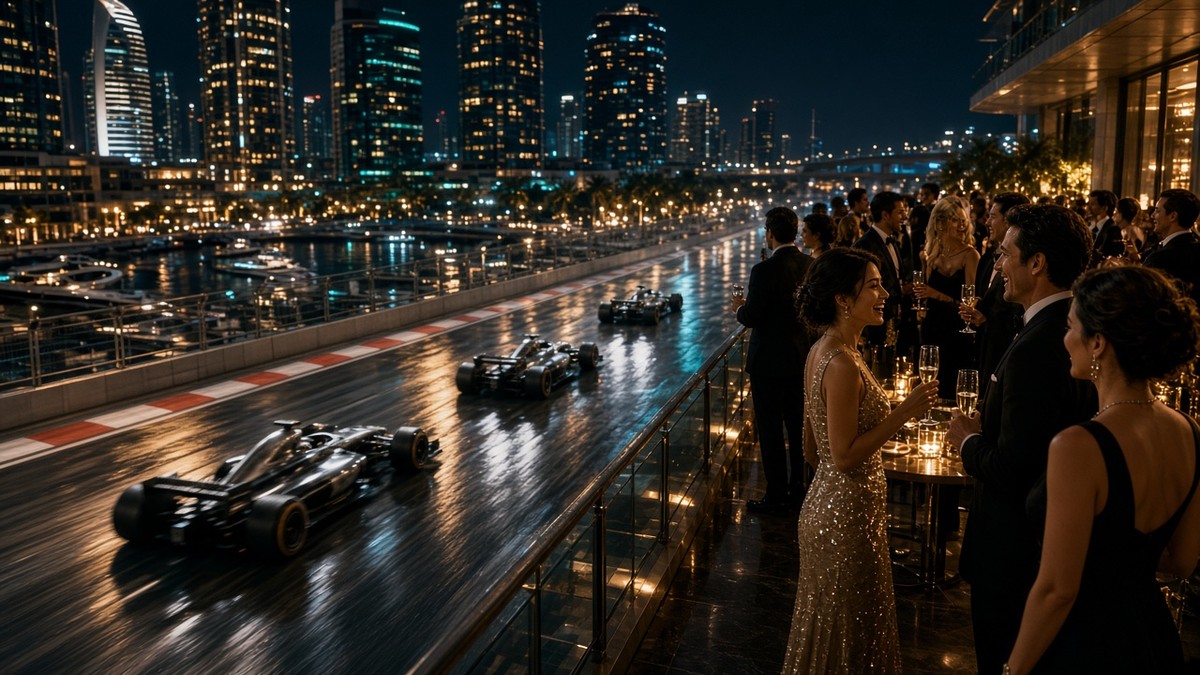
The title fight is already a story a studio would pitch. On 1 November, Formula 1 reported that Kimi Antonelli became the youngest ever World Champion by finishing third in Mexico City at age 20, with Max Verstappen winning the race and Lewis Hamilton second. A week later in Sao Paulo, Mercedes sealed the constructors’ title for the first time since 2021, while Lando Norris won in the wet and Hamilton, on his 400th Grand Prix start, finished ninth. The next stop is the Las Vegas Strip, where the future of Grand Prix looks less like a closed garage and more like a Saturday-night premiere.
The money is catching the glamour. Sportico’s 2026 valuations, as reported by GiveMeSport and MotorBiscuit, put Ferrari first at $8.2 billion, Mercedes at $7.75 billion and McLaren at $6.3 billion, with Red Bull at $5.6 billion. The 11 teams were valued at $50 billion in total, with an average of $4.55 billion, up 33% in a year. Audi was put at $3 billion and newcomer Cadillac at $2.7 billion. Sportico also reported a $450 million dilution fee for Cadillac’s entry, or $45 million for each of the existing teams. Formula 1 itself sits under Liberty Media’s Formula One Group tracking stock, the FWONA and FWONK lines named in Apple’s own rights announcement. Global Celebrity Meter has already asked which sport makes the most money. This is what the answer looks like when the franchises get heavier.
The camera deal completed the glow-up. In October 2025 Apple and Formula 1 announced a five-year partnership making Apple TV the exclusive U.S. home for every practice, qualifying session, Sprint and Grand Prix from 2026, with all practices and some race weekends also free in the app. Apple tied the pact to F1 The Movie, the Apple Original starring Brad Pitt and produced with seven-time champion Lewis Hamilton, Jerry Bruckheimer and Joseph Kosinski. Apple said the film had crossed $629 million worldwide by mid-October 2025 and called it the highest-grossing sports movie of all time. Box Office Mojo later listed the worldwide total at about $634 million. Apple also said the U.S. fanbase reached 52 million in 2024, and cited the 2025 Global F1 Fan Survey with Motorsport Network: 47% of new U.S. fans, those following for five years or less, were aged 18 to 24, and more than half were female. Netflix’s Drive to Survive had already turned team radios into prestige television. On Liberty Media’s third-quarter 2026 earnings call, covered by 9to5Mac and Yahoo Sports, Formula 1 CEO Stefano Domenicali said Apple would bid for rights in other countries as those contracts open, and Liberty CEO Derek Chang said even the prospect of Apple bidding tightens the market.
That is why the paddock now feels like fashion week with sharper corners. Drivers are treated as global faces, not just helmets. The Las Vegas date sits on the same calendar as the sport’s U.S. media bet. Hamilton is both a championship fixture and a film producer. The market already prices a famous name like an asset, and bookers now work from audited 2027 appearance rate cards. Limited Editions Europe has walked through the same world of celebrity supercars and villas, while Billionaire Meter’s Global Sensex & multi-dimensional wealth index is how capital desks read a team that now looks like a luxury house. The future of Grand Prix is the point where a new car, a new city, a streaming giant and a celebrity brand all hit the same apex.
FAQ
What is the future of Grand Prix under the 2026 rules?
The future of Grand Prix is being built on smaller, lighter cars, active aerodynamics that replace DRS, power units that aim for about half their output from electrical energy, and 100% advanced sustainable fuel, as set out by the FIA and Formula 1.
Who is the 2026 Formula 1 world champion?
Formula 1 reported that Kimi Antonelli, 20, became the youngest ever World Champion by finishing third at the Mexico City Grand Prix on 1 November 2026. Mercedes then sealed the constructors’ title at the Sao Paulo Grand Prix on 8 November, its first since 2021.
How much are Formula 1 teams worth now?
Sportico’s 2026 valuations, as reported by GiveMeSport and MotorBiscuit, put Ferrari at $8.2 billion, Mercedes at $7.75 billion and McLaren at $6.3 billion. The 11 teams were valued at $50 billion in total, with an average of $4.55 billion, up 33% in a year. Cadillac, the new 11th team, was valued at $2.7 billion.
Who holds Formula 1 rights in the United States?
Apple and Formula 1 announced in October 2025 a five-year deal making Apple TV the exclusive U.S. home of every practice, qualifying session, Sprint and Grand Prix from 2026. On Liberty Media’s third-quarter 2026 earnings call, Stefano Domenicali said Apple would bid for rights in other countries as contracts open.