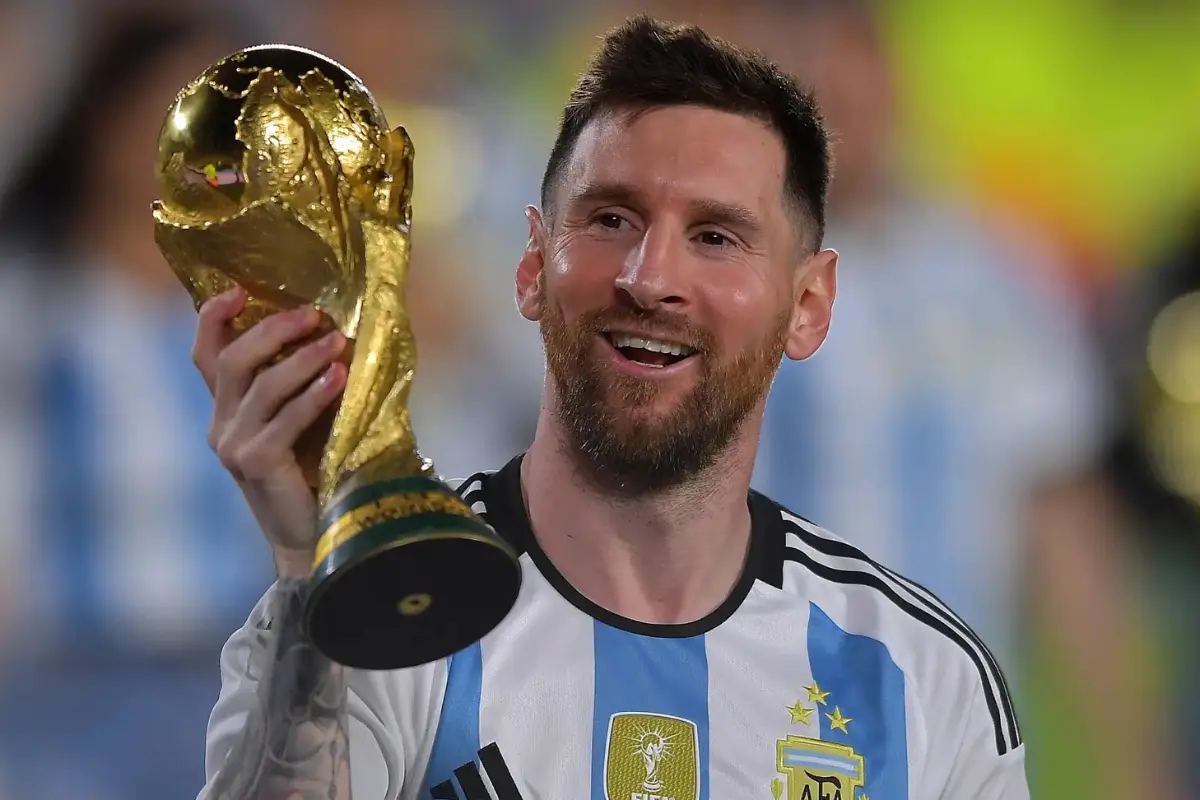
Lionel Messi’s rise began in Rosario, in a working-class home, with a growth-hormone bill his family could not cover. Then Barcelona signed a napkin contract. Eight Ballon d’Ors and a World Cup followed. Those lessons still hold today, in 2026.
Global Celebrity Meter
Ranked on Global Celebrity Meter 2026
Lionel Messi’s rise started in a Rosario steel town
Lionel Andrés Messi was born on 24 June 1987 in Rosario, in Argentina’s Santa Fe Province. This was not a rags-to-palace fairy tale, and it was not destitution either. The Athletic has written that the Messis were not poor: his father, Jorge, was a section head at Acindar, the huge metal works in the area. Yahoo has described Jorge as a metal-factory supervisor, and Celia Cuccittini, Messi’s mother, as having worked part-time as a house cleaner and at a magnet factory. It was a working-class household. What the wage could not cover was the medical bill that arrived when Messi was still a child.
AP News has reported that in 1992 his maternal grandmother, also named Celia, took five-year-old Lionel to watch his older brother play for Grandoli, then talked the coach, Salvador Aparicio, into putting the smaller boy on the pitch when a side was short. The BBC notes that he joined Newell’s Old Boys, the Rosario club Jorge supported, at seven. That is the unglamorous opening of Lionel Messi’s rise: a steel town, a grandmother, a local club, and a body that was about to become the problem.
The growth-hormone bill, and the napkin that changed everything
Sports Illustrated, in a 2010 profile by S.L. Price later recounted by Business Insider, reported that Messi began growth-hormone treatment at 11, at a cost of $1,500 for a 45-day cycle. The Guardian has put the bill at almost $1,000 a month. The Athletic has used about $900 a month, and stressed that even a section head’s pay could not meet it. ESPN has cited around €1,000 a month, and noted that neither Barcelona nor Messi has confirmed the amounts. The figures move. The bind does not.
According to that Sports Illustrated account, Jorge’s company coverage ran out when Messi was 13. Newell’s made a few $500 payments, then stopped. Barcelona agreed to pay for the treatment if he signed. Sid Lowe, writing in The Guardian, described the daily injections into Messi’s legs, and the club’s need to find work for his father.
The family flew in for a trial. The Guardian dates the arrival at Barcelona’s El Prat airport to 17 September 2000, when Messi was 13 and traveling with Jorge. The club then stalled. On 14 December 2000, at the Pompeia tennis club, sporting director Charly Rexach met intermediaries Josep Maria Minguella and Horacio Gaggioli. “His dad was getting angry and said Leo was leaving,” Rexach later told the sports daily AS, The Guardian reported. Rexach pulled a serviette from a plastic holder and wrote a commitment to sign Messi. The BBC says the family relocated to Spain in February 2001. Celia and Messi’s siblings later returned to Rosario. Jorge stayed. Lionel Messi’s rise is often told as a miracle. The paper trail is more blunt: a parent who refused to wait, a napkin, and a medical invoice that finally got paid.
From a 10-minute debut to 8 Ballon d’Ors
Messi’s competitive Barcelona debut came on 16 October 2004, against Espanyol at Montjuïc, The Guardian reports. He was 17. He replaced Deco in the 82nd minute. Asked about the shirt, he said it was for his mum, who was back in Argentina, and added: “I will remember those 10 minutes my whole life.”
The BBC, in its 2026 accounting, records 17 first-team seasons at Barcelona, 10 La Liga titles and four Champions League trophies, plus a record eight Ballon d’Or awards, in 2009, 2010, 2011, 2012, 2015, 2019, 2021 and 2023, as listed on Messi’s official honours page. He captained Argentina to the 2022 World Cup in Qatar, and to two Copa América titles, the second of them a successful defense in 2024, The Guardian and the BBC both note. After leaving Barcelona in 2021 and a spell at Paris Saint-Germain, he joined Inter Miami in 2023.
He is on GCM’s Hottest Celebrities on Earth, 2026 list, and on our World’s Top Ten Global Stars file. For the money layer, see Celebrityfees’ Lionel Messi 2026 earnings file and the Highest-Paid Athletes 2026 Forbes list, alongside GCM’s Highest-Paid Soccer Players 2026 briefing. Forbes, in its October 2026 soccer ranking, estimated him at $145 million for the 2026/27 season, with about $70 million tied to Inter Miami. In May, Forbes’s world’s highest-paid athletes list had him at $140 million, split evenly on and off the field. See Billionaire Meter on how billionaire rankings are measured.
Where Lionel Messi stands in November 2026
The fairy tale did not get a clean last page. On 19 July 2026, in the World Cup final in New Jersey, Spain beat Argentina 1-0 after extra time, The Guardian reported, with Ferran Torres scoring. The BBC says Messi still produced eight goals and four assists in that tournament. In August, Jorge Messi died in Rosario at 68, after a long illness, the BBC and The Independent reported. He had been his son’s agent since Messi was 14.
On 31 August 2026, Messi announced his retirement from international football. The BBC and The Guardian report that he posted notes written on 21 July, two days after the final, and that after his father’s death he felt “more convinced than before.” He finished with 125 goals in 207 appearances, Argentina’s all-time leading scorer and most-capped player, the BBC says. In October, after a friendly win over Benin, he told the crowd that not coming back would be “deeply painful,” The Guardian reported, citing Agence France-Presse.
He has not walked away from club football. MLSSoccer.com, previewing Inter Miami’s playoff series against Columbus Crew, called Miami the defending MLS Cup champions, noted a Campeones Cup win in September, and said Messi produced a league-best 43 goal contributions this season, 26 goals and 17 assists, to win a second straight Golden Boot. Goal reported on 6 November that Fabrizio Romano said Messi planned to see out his Inter Miami contract, extended in 2025 through the 2028 season, and had no plan to leave on loan for Newell’s.
What Lionel Messi’s rise teaches you
1. Working-class is not the same as being able to pay the bill that matters. The Athletic’s point still cuts. A supervisor’s wage at a steel plant can look solid until a monthly medical invoice arrives. Talent was never the only scarce resource.
2. Someone has to refuse the stall. The napkin is not a cute origin myth. It is what happened when Jorge was ready to walk and Rexach signed the only paper in reach.
3. The dream can split a family in half. The BBC’s timeline is plain: the move to Spain in 2001, his mother and siblings going back to Rosario, his father staying. The first-team shirt in 2004 was for his mum, who was not in the stands.
4. The second act is showing up after the ending. 2026 brought a World Cup final loss, his father’s death, and an international goodbye. He is still in Miami, still under contract through 2028, still posting Golden Boot numbers in a playoff series this month. For more on how champions handle the unglamorous years, see Motivations Masters.
5. Earnings are a lagging indicator, not the plot. The Forbes figures are enormous, and late. The plot started with a treatment the family could not fund. The reported commercial ranges live on Celebrityfees. VIP access for the Let’s Do It for the Planet world tour sits on The Global Concert.
FAQ
Was Lionel Messi poor as a child?
Not in the sense of destitution. The Athletic has written that the Messis were not poor, and that Jorge was a section head at the Acindar metal works. Yahoo has described him as a metal-factory supervisor, and Celia as having worked part-time as a house cleaner and at a magnet factory. It was a working-class Rosario household. The pressure came when growth-hormone treatment, reported by outlets at about $900 to $1,000 a month, or $1,500 per 45-day cycle, outran that wage.
Why did Messi leave Rosario for Barcelona at 13?
Because the treatment bill could not be sustained at home. Sports Illustrated reported that Jorge’s company coverage stopped, Newell’s made only a few payments, and Barcelona agreed to fund the medicine if he signed. After a September 2000 trial, Charly Rexach signed a napkin commitment on 14 December 2000. The BBC says the family relocated in February 2001.
How many Ballon d’Or awards has Lionel Messi won?
Eight: in 2009, 2010, 2011, 2012, 2015, 2019, 2021 and 2023, as listed on his official honours page and cited by the BBC in 2026. That remains the men’s record.
Did Argentina win the 2026 World Cup, and does Messi still play?
No, and yes, at club level. The Guardian reported that Spain beat Argentina 1-0 after extra time in the 19 July 2026 final in New Jersey, with Ferran Torres scoring. Messi announced his international retirement on 31 August 2026, the BBC and The Guardian reported. He remains with Inter Miami, whose contract with him runs through the 2028 season, and entered the 2026 MLS Cup playoffs as part of the defending champions, MLSSoccer.com says.