X Ray Scanner is Global Celebrity Meter’s series for a close look at a single event, read from the public record. This Titanic sinking analysis turns to the night of April 14 and 15, 1912, when the White Star liner Titanic, on her maiden voyage from Southampton to New York, struck an iceberg in the North Atlantic and foundered. So many people lost their lives. The question that still follows, more than a century later, is a simple one: could more of them have been saved? The answer belongs to the official inquiries, to later research, and to a chain of decisions and conditions, not to easy blame.
1. A Clear Night on a Tight Timeline
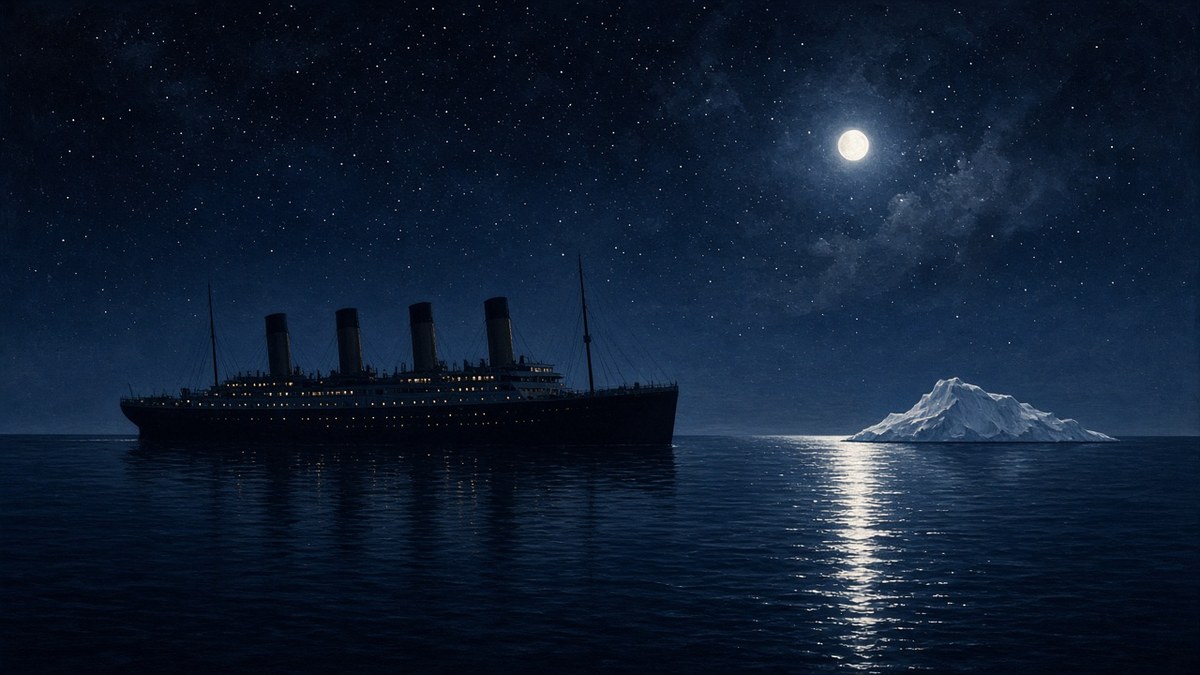
The British Wreck Commissioner’s inquiry placed the collision at about 11:40 p.m. ship’s time on April 14, and the foundering at 2:20 a.m. on April 15, at latitude 41 degrees 46 minutes north, longitude 50 degrees 14 minutes west. From the first blow to the last moment, a little more than two hours and forty minutes passed.
Second Officer Charles Lightoller handed the watch to First Officer William Murdoch at 10 p.m., telling him the ship was within the region where ice had been reported, the British report records. A little before 11:40, a lookout in the crow’s nest struck three bells and telephoned the bridge: “Iceberg right ahead.” Murdoch ordered the helm hard a starboard, signaled the engine room to stop and then go full speed astern, and closed the watertight doors. The ship’s head had fallen off about two points to port when she struck the iceberg well forward on her starboard side. When Captain Edward Smith came onto the bridge, Murdoch told him that he had put the helm over, reversed the engines, and had been about to swing the stern clear, but the berg was too close. He had already closed the watertight doors. The British inquiry later found that those measures were proper and were taken promptly.
2. Ice Warnings Reached the Ship
The Titanic received several ice warnings on April 14. The US Senate inquiry found that at least three of them reached the commander that day. They included a noon message from the White Star liner Baltic reporting icebergs and a large quantity of field ice near the track, a message from the Leyland liner Californian about large bergs to the north of the track, and a report from the steamer Amerika of icebergs to the south. A later Californian message, sent when that ship was stopped and surrounded by ice, arrived while Titanic’s wireless operator was busy working traffic with Cape Race. The Senate report records that the reply was that he was occupied. The Californian’s operator then ended his watch for the night.
The Senate committee wrote that ice had been reported on both sides of Titanic’s track and in her immediate vicinity, that no conference of officers was called to consider the warnings, that speed was not reduced, and that the lookout was not increased, beyond instructions to keep a sharp lookout for ice. Captain Smith, the report notes, told Lightoller that if it were in the slightest degree hazy they would have to go very slowly, and to let him know if anything were doubtful. The evidence before the committee was that the night was exceptionally clear.
3. Speed and the Lookouts
The British inquiry found that the ship’s speed shortly before the casualty was about 22 knots, and that this speed was excessive under the circumstances. No directions were given to reduce speed. The Court also found that the lookout for ice was not, in its view, sufficient given the moonless night, the lack of wind, and the high speed: an extra lookout should have been placed at the stem, and a sharp lookout kept from both sides of the bridge by an officer. The men in the crow’s nest had been warned at 9:30 p.m. to keep a sharp lookout for ice, particularly small ice and growlers.
Were binoculars provided for and used by the lookout men? The Court’s answer was no. It also found that the use of them was not necessary or usual in such circumstances. The lookouts’ own testimony that they did not have binoculars that night is part of the record. Whether glasses would have given earlier warning remains a possibility, not a finding of the Court.
4. A Glancing Blow and a Five Compartment Problem
The British inquiry described the casualty as a collision with an iceberg that pierced the starboard side in several places below the waterline, between the forepeak tank and No. 4 boiler room. Later writers have summarized that damage as a breach of more than five compartments. The ship was divided by 15 transverse watertight bulkheads into 16 compartments, and was designed to remain afloat with any two adjoining compartments flooded. A glancing blow that opened more than that number of spaces was more than the design was meant to meet.
Sonar work on the wreck, as later described by the US National Institute of Standards and Technology, has shown only slim openings in the starboard hull, with a total open area of about one square meter, rather than a single great gash. Water could still enter in several places along the bow, and that was enough.
5. Bulkheads, Rivets and Steel
In 1998, NIST metallurgist Tim Foecke published an analysis of steel and rivet samples recovered from the wreck. He found that the hull steel had a ductile to brittle transition temperature that was high for this type of steel, making the material brittle in the icy seawater of the North Atlantic, and that the wrought iron rivets contained an elevated amount of slag, which could make them more brittle in the cold. A later microscopic study of Titanic rivets reported highly variable slag and suggested that rivet heads may have been prone to fail under load, allowing hull plates to separate. These are research findings, not a verdict that the ship was badly built. The British inquiry, asked whether she was properly constructed and adequately equipped as a passenger steamer when she left Queenstown, answered yes, and found that she had complied with the Merchant Shipping Acts and the rules then in force.
The bulkheads themselves did not rise through the full height of the ship. Once the bow had settled far enough, water could pass from one space into the next over the tops of the bulkheads. That is a design condition, recorded in the inquiry’s description of the ship, and it helps explain why a ship built to survive two flooded compartments could not survive this particular injury.
6. Lifeboats, Rules and Empty Seats
Titanic carried 20 boats: 14 lifeboats for 65 people each, two emergency boats for 40 each, and four Engelhardt collapsible boats for 47 each, a total capacity of 1,178, the British inquiry found. More than 2,200 people were on board. The boats exceeded the Board of Trade rules of the day, which were based on a ship’s tonnage, not on the number of people she carried. For a vessel of 10,000 tons and upward, the table then in force required 16 boats under davits and, with the extra provision for emigrant ships, accommodation that the inquiry calculated at 9,625 cubic feet, or about 962 people. Titanic’s 11,325 cubic feet and 1,178 places went beyond that legal minimum. The minimum, however, was never enough for everyone on a ship of this size.
The Court also found that the arrangements for manning and launching the boats were not proper and sufficient, and that no proper boat drill or muster had been held. Several of the earlier boats left with many empty places. A NIST account of the night notes that the first boat, built for 65 people, left with 28. The inquiries recorded that many passengers at first were reluctant to leave a liner that still seemed steady, and that the night was dark and the danger not at first clear to all. Second Officer Lightoller and his colleagues on the boat deck worked under those conditions to fill and lower what boats they had, with the order that women and children should go first shaping how the early boats were loaded.
The eight musicians, listed among the second class passengers, continued to play as the boats went away, a service that survivors have remembered with gratitude. In the wireless cabin, Jack Phillips and Harold Bride stayed at their key, sending the CQD and then the SOS that brought help. Phillips did not survive the night. Bride did, and later described the work they had done. Below, engineers and stokers kept light and power on the ship for as long as they could. These are part of the same record as the empty seats.
7. Two Ships on the Horizon: Californian and Carpathia
The Leyland liner Californian had stopped for ice for the night. Her wireless operator had gone off duty. Officers on her bridge saw rockets. The British inquiry concluded that the ship they saw was the Titanic, that the two vessels were probably no more than eight to ten miles apart, that the ice in between was loose, and that when she first saw the rockets the Californian could have pushed through to open water without any serious risk and come to Titanic’s aid. “Had she done so she might have saved many if not all of the lives that were lost,” the Court wrote. Asked which vessels had the opportunity of rendering assistance before Carpathia arrived, the Court named the Californian, and said she could have reached Titanic if she had made the attempt when she saw the first rocket, and that she made no attempt. Those are the 1912 findings. A later British Marine Accident Investigation Branch reappraisal in 1992 returned to questions of distance and what could be seen from the bridge, and the debate has continued. This column records the Court’s conclusion, and the fact that the Californian did steam toward the scene in the morning and join the search.
The Cunard liner Carpathia, under Captain Arthur Rostron, received the distress call and turned toward Titanic. Rostron testified, and later accounts including National Museums Liverpool have recorded, that his ship was about 58 miles away. He doubled lookouts, prepared his own boats, and drove through a night of ice. The US Senate inquiry called his conduct deserving of the highest praise. He stopped engines at 4 a.m., picked up the first boat at 4:10 a.m., and had the last of the survivors on board by 8:30 a.m. Carpathia picked up 15 lifeboats and two collapsible boats, then made for New York.
The Human Toll, as the Inquiries Counted It
Figures vary by source, and no single list has ever closed every discrepancy. The US Senate inquiry recorded 2,223 people on board, 706 saved and 1,517 lost. The British inquiry recorded 2,201 on board, 711 saved and 1,490 lost. Researchers associated with Encyclopedia Titanica have often worked from a total of about 2,208 on board, with 712 survivors and 1,496 lost, reflecting later work on how postal workers, musicians and others were classified. The British inquiry counted 109 children among the passengers: 6 in first class, 24 in second class and 79 in third class. According to that table, all of the children in first and second class were saved, while survival among children in third class was much lower. Adult survival also differed sharply by class and by sex. These are counts, not a hierarchy of grief. Every life on the list was a life.
Could More Lives Have Been Saved?
The question is the right one, and it should be answered as a set of possibilities, not as a rewritten night.
If the helm order had come earlier, or if the ship had met the iceberg with her bow, might she have stayed afloat? Edward Wilding, a senior naval architect at Harland and Wolff, told the British inquiry that if she had struck a fair blow with her stem, he was quite sure the ship would have come into harbour. He believed the bow might have crumpled for 80 or perhaps 100 feet, at a terrible cost to men in the forward crew spaces, but that the damage would have stopped before the second bulkhead, leaving the ship able to float. Later researchers, including a technical paper published by Encyclopedia Titanica, have continued to test that view. It remains a serious possibility, not a fact.
If the lookouts had had binoculars, might they have seen the berg a little sooner? The Court did not find glasses necessary or usual. The possibility is still discussed, and it cannot be proved. If the ice warnings had led to a reduction in speed, or to a course further south, the collision might never have happened. The British inquiry found the speed excessive. That is the clearest official judgment on the night’s navigation.
If the ship had carried boats for all, and if the earlier boats had been filled, many more people might have left the liner before 2:20 a.m. The legal minimum of 1912 did not require that capacity. The empty seats are part of the official story, and so is the confusion of a first lowering on a night without a proper drill. If the Californian had come when the rockets were seen, the British inquiry said, she might have saved many if not all of those who were lost. That, too, is a possibility the Court itself was willing to state. None of these paths can be walked now. Together they explain why the night still feels unfinished.
What Changed Afterward
In 1914, two years after the disaster, maritime nations meeting in London adopted the first International Convention for the Safety of Life at Sea, known as SOLAS, a history later set out by the International Maritime Organization. War delayed that first treaty from coming into force, and later SOLAS conventions carried the lessons forward: enough lifeboats for everyone on board, a continuous radio watch at sea, and moderate speed or a change of course when ice is reported at night. The same period saw international support for an ice patrol in the North Atlantic. The International Ice Patrol, today conducted by the United States Coast Guard, still tracks bergs on the transatlantic lanes.
Public inquiries can change the systems people live by, a pattern Global Celebrity Meter has also traced in its account of the 1929 Wall Street crash and the rules that followed. Today’s liners sail under a far denser web of safety rules than the Titanic did. For a look at how the modern cruise world now presents itself, see our ranking of the world’s most luxurious cruises for 2026 and 2027. The private yacht life of the present is a different map again, as Billionaire Meter’s guide to how billionaires live sets out.
Why It Matters
The Titanic sank because an iceberg opened more of her than her bulkheads were meant to hold, after a high speed run into a region of reported ice, on a moonless night, with too few boats for the people she carried, and with a nearby ship that did not come until morning. That is the official story, told without scorn for the people who had to live it. The crew who launched the boats, the musicians who played, the operators who stayed at the wireless, the engineers who kept the lights on, and the Carpathia company who crossed the ice to reach them, are part of why anyone was saved at all. The lasting question is not who to blame. It is what the night taught the sea, and whether we still remember it.
FAQ
Why did the Titanic sink?
The British Wreck Commissioner’s inquiry found that the loss was due to a collision with an iceberg, brought about by the excessive speed at which the ship was being navigated. The berg opened the starboard side in several places between the forepeak tank and No. 4 boiler room, more than the two adjoining compartments the bulkheads were designed to withstand. The ship struck at about 11:40 p.m. on April 14, 1912, and foundered at 2:20 a.m. on April 15.
How many people died on the Titanic, and how many survived?
Figures vary by source. The US Senate inquiry recorded 2,223 people on board, 706 saved and 1,517 lost. The British inquiry recorded 2,201 on board, 711 saved and 1,490 lost. Researchers associated with Encyclopedia Titanica have often used a total of about 2,208 on board, with 712 survivors and 1,496 lost, after later work on how some groups were classified.
Did the Titanic have enough lifeboats?
She carried 20 boats with a total capacity of 1,178 people, the British inquiry found, which was more than the Board of Trade rules then required for a ship of her tonnage, but far fewer places than the more than 2,200 people on board. Several of the earlier boats also left with many empty seats. A NIST account of the night notes that the first boat, built for 65 people, left with 28.
Could the Titanic have been saved?
There is no single proven answer, only evidence based possibilities. Edward Wilding of Harland and Wolff told the British inquiry he was quite sure the ship would have come into harbour if she had met the iceberg with her bow. The Court found the speed excessive and said the Californian might have saved many lives if she had come when the rockets were seen. More boats, fuller early boats, and a slower approach after the ice warnings are also widely discussed. None of these paths can be tested now.
What safety rules changed after the Titanic sank?
In 1914, maritime nations meeting in London adopted the first International Convention for the Safety of Life at Sea, known as SOLAS. War delayed that first treaty from coming into force, and later SOLAS conventions carried the lessons forward: enough lifeboats for everyone on board, a continuous radio watch at sea, and moderate speed or a change of course when ice is reported at night. The same period saw the creation of the International Ice Patrol, still conducted by the United States Coast Guard.
Keep reading
- The World’s Most Luxurious Cruises 2026-2027: Ranked by Price and Prestige
- 1929 Wall Street Crash: Black Thursday, Lost Fortunes and the Rules That Followed
- 5 Records From GTA VI, Biggest Launch in History 2026
Sources
Named in text, no outbound links: British Wreck Commissioner’s Inquiry, report and findings, including the collision narrative, questions 2, 5, 10, 11, 13, 14, 23, 24 and 25, the description of the ship and structure, the boats report, the Board of Trade administration chapter, the Californian chapter, and Appendix 10 on lives lost and saved (1912); US Senate Inquiry report chapters on the voyage, ice warnings, the rescue, and passenger and survivor counts (1912); testimony of Edward Wilding, British inquiry Day 19 (June 7, 1912); testimony of Arthur H. Rostron, US Senate Inquiry Day 1; Tim Foecke, “Metallurgy of the RMS Titanic,” National Institute of Standards and Technology (1998), and NIST’s later summary of the rivet and hull findings, including the first boat figure of 28 people; microscopic rivet study reported in “Microscopic Analysis of Metal Recovered from the Wreck of RMS Titanic”; Encyclopedia Titanica, including later discussions of casualty counts and Richard Elliott’s paper on a head on impact; International Maritime Organization, “Surviving disaster: The Titanic and SOLAS”; United States Coast Guard history of the International Ice Patrol; National Museums Liverpool account of the Carpathia rescue; Marine Accident Investigation Branch, “RMS Titanic: Reappraisal of Evidence Relating to SS Californian” (1992).