Janus Metz’s Unabomber takes a closer look at the early life of Ted Kaczynski, the brilliant mathematician who later became infamous as the Unabomber. Rather than attempting to cover his entire life, the film concentrates primarily on Kaczynski’s years at Harvard and the controversial psychological experiment that the movie suggests played a role in shaping his later worldview.
Written by Sam Chalsen and Nelson Greaves, the thriller moves between two periods in Kaczynski’s life. The first takes place during his college years in the 1950s, when he was an exceptionally young and gifted Harvard student. The second jumps forward to the 1990s, when investigators were attempting to identify and capture the person responsible for a series of deadly bombings.
The film builds much of its central argument around Harvard psychologist Henry Murray, played by Russell Crowe. Murray oversees a psychological study in which students are subjected to intense ideological and psychological pressure. Unabomber presents the experience as a potentially decisive event in Kaczynski’s transformation, suggesting that it contributed to his growing hostility toward academia, modern technology and the institutions around him.
That interpretation, however, is one of the film’s biggest weaknesses. Rather than exploring the complicated factors behind Kaczynski’s radicalization, the screenplay often treats the psychological experiment as an overly convenient explanation. The result is a narrative that appears to want to explain an extraordinarily complicated individual through a relatively straightforward cause-and-effect storyline.
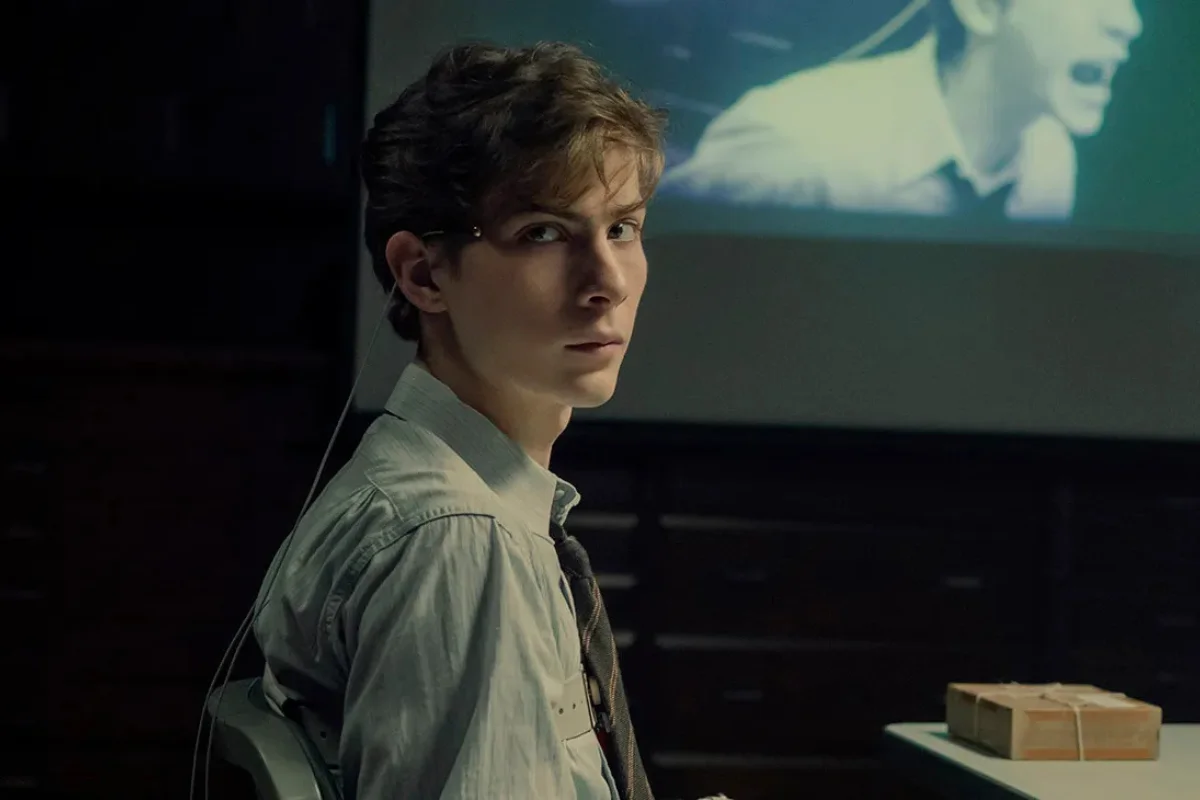
Jacob Tremblay plays the young Kaczynski, and his physical resemblance to the real figure is striking. Tremblay captures the character’s youth and intellectual confidence, particularly through his nervous energy and intense expressions. Yet the performance struggles to communicate the deeper psychological transformation the screenplay requires.
Kaczynski is supposed to evolve from an exceptionally intelligent but inexperienced teenager into someone increasingly consumed by anger and radical ideas. The transition, however, rarely feels convincing. Too often, his behavior comes across as immature or rebellious rather than genuinely disturbing.
Also read: Marvel Unveils Fresh ‘Avengers: Doomsday’ Character Artwork in Stunning First-Look Poster
The Harvard sections nevertheless provide some of the film’s strongest atmosphere. Metz creates a tense portrait of American academia during the early Cold War, a period when universities and government institutions were increasingly interested in psychology, intelligence and methods of understanding human behavior.
Russell Crowe brings a restrained presence to Henry Murray. His performance suggests a professor who is simultaneously fascinated by Kaczynski’s intelligence and willing to push ethical boundaries in pursuit of his research. There is an unsettling quality to the character, but the screenplay does not give Crowe enough material to fully explore the relationship between Murray and his young subject.
Much of the experiment instead unfolds through Kaczynski’s interactions with another student, played by Gus Halper. These encounters add tension to the Harvard storyline, but they do not provide the psychological depth needed to make Kaczynski’s eventual transformation feel inevitable or even particularly persuasive.
The film’s 1990s investigation is even less distinctive. Shailene Woodley plays Joanne, an investigator attempting to uncover clues hidden within Kaczynski’s writings. Her character is positioned as an outsider trying to understand the mind behind the manifesto, but the investigation follows familiar crime-thriller conventions.
Some scenes feel especially formulaic, with investigators studying documents and searching for seemingly hidden meanings in Kaczynski’s words. Instead of creating a genuinely complex portrait of the investigation, the movie frequently settles for familiar FBI-thriller beats.
Woodley gives the role as much personality as possible, but the character is limited by the writing. Her emotional journey becomes more apparent toward the conclusion, when the pressure of the case finally catches up with her.
Unfortunately, the film’s final emotional moment feels too familiar. The filmmakers attempt to give Joanne a private moment of release after the investigation, but the sequence recalls the emotional conclusion of Zero Dark Thirty too closely to have the intended impact.
Ultimately, Unabomber has an intriguing premise but does not explore it with enough sophistication. The idea of examining Kaczynski’s college years, his exposure to controversial psychological research and the investigation that eventually brought him down could have produced a fascinating psychological thriller.
Instead, the movie presents a relatively simple explanation for a deeply complicated story. Its strongest qualities are its period atmosphere and the performances of Crowe, Tremblay and Woodley, but the screenplay repeatedly falls back on familiar storytelling techniques.
The result is a film that provides the broad outlines of Kaczynski’s story without uncovering much that feels genuinely revealing. Unabomber may have the ingredients for a challenging examination of radicalization, but it ultimately feels more like a conventional thriller than the penetrating psychological drama it aims to be.