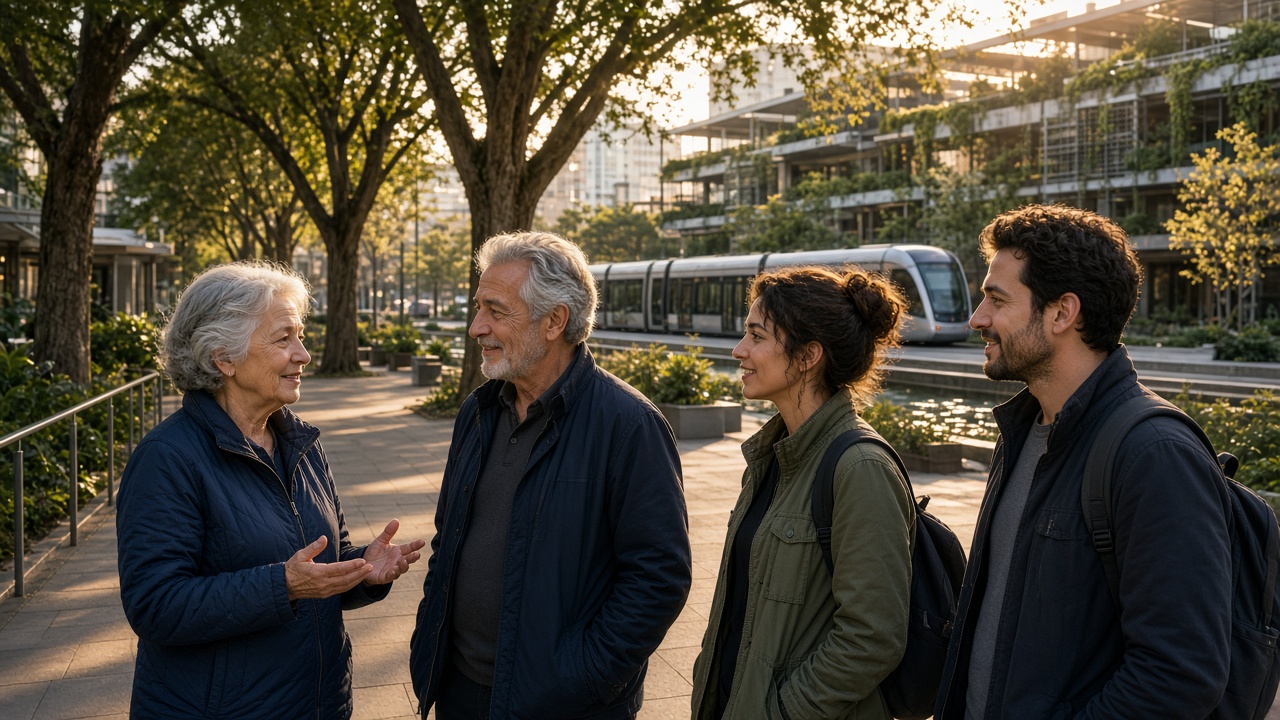
Imagine a woman of 75 stepping outside in 2076. She remembers the first smartphone she owned, the pandemic that interrupted her youth and the strange moment when machines began answering back. Now she pauses under a shaded walkway, waiting for someone much younger. The question occupying her is not whether the world looks futuristic. It is whether she still has a place in it.
This is an imagined scene, not a prediction. But its central character is already alive. Using the common, though not universal, 1997 to 2012 birth range, Gen Z will turn 64 to 79 during 2076. Exact ages depend on birthdays. The generation discussed as tomorrow’s workforce will be approaching or living through old age.
That change of perspective makes the next 50 years more interesting than any catalogue of inventions. What kind of society will Gen Z help build while young, and what will that society owe them when they are old?
The machine question is really an ownership question
Much discussion of artificial intelligence begins with a contest: will humans beat machines? For most people, a more consequential question may be who owns the machines, who sets their terms and who receives the income they generate.
A 2025 study by the International Labour Organization and NASK estimated that one in four jobs worldwide was potentially exposed to generative AI. That is not a prediction that a quarter of jobs will disappear. The researchers judged transformation more likely than replacement because most occupations contain tasks requiring human involvement.
Over five decades, the balance could change in ways nobody can responsibly quantify today. Better software might let smaller teams produce more, help doctors interpret information or give small businesses capabilities once reserved for giants. It might also weaken workers’ bargaining power if employers capture the gains without sharing them.
GCM’s coverage of competition for AI talent examines the attention surrounding a narrow group of highly sought-after people. The wider social test is what happens to everyone outside that circle.
A productive economy could support shorter working hours, stronger public services or more secure retirement. It could instead produce spectacular corporate wealth alongside households permanently anxious about the next contract. Neither outcome comes bundled with the technology. Tax systems, competition rules, worker representation and ownership arrangements help determine the difference.
A longer life is not the same as a better old age
The United Nations’ World Population Prospects 2024 describes a demographic transition towards longer lives and smaller families, while stressing different trajectories across countries. Its projections explore plausible outcomes, not a single inevitable future.
That distinction matters. Ageing societies and countries with growing young populations will not face identical pressures. Pension systems, family support and access to healthcare differ enormously. There is no single global retirement waiting for Gen Z.
Medical advances could improve later life. But promises of dramatically extended human lifespans should not substitute for the less glamorous work of preventing illness, making buildings accessible and ensuring someone can afford help after a fall.
Care is where an abstract future becomes intimate. A device might detect a problem or help someone navigate a room. It cannot settle who pays a care worker, whether that worker has decent conditions or whether an older person has any choice about where to live.
If care continues to depend heavily on unpaid family labour, the costs may fall unequally on women and relatives with the least bargaining power. A wealthy Gen Z retiree and a lifelong informal worker could inhabit the same technological era yet experience profoundly different versions of ageing.
The future will arrive through the front door
For many people, climate change in 2076 may be experienced less as a planetary graph than as a housing question. Can this home remain comfortable during dangerous heat? Can the neighbourhood drain after heavy rain? Is moving possible, affordable or even wanted?
The IPCC’s 2023 synthesis found that every increment of warming intensifies multiple hazards. It also documented benefits from adaptation, including urban greening and early warning systems, while warning that adaptation has limits and remains unevenly funded.
Those findings do not tell us exactly what any particular city will look like in 2076. They explain why decisions about buildings, transport, water and land made now can shape daily life decades later.
Where hazard exposure rises, repair costs and insurance pricing could place additional pressure on households. Where formal insurance is scarce, families and governments may have to absorb more losses themselves. Protecting valuable property while neglecting renters or informal settlements would turn adaptation into another mechanism for widening inequality.
The hopeful possibility is practical rather than cinematic: cooler homes, reliable electricity, shaded streets and public transport that works for bodies of different ages. A city designed for an older resident can also become easier for a child, a parent or someone with a disability to navigate.
Being connected will not guarantee being known
Gen Z may carry an extensive digital record into old age: photographs, messages, recordings and versions of themselves preserved across platforms. Whether those archives remain accessible will depend on companies, formats, consent and decisions made long before 2076.
The emotional questions are already appearing in culture. GCM’s report on Almost You and its exploration of AI and grief touches a dilemma that could become more familiar: what is the difference between preserving traces of someone and replacing their presence?
Artificial companions might offer comfort to some people. They could also create dependency or become a cheaper substitute for human contact that institutions no longer wish to provide. The issue is not whether every digital relationship is false. It is whether people retain meaningful choices beyond it.
Purpose will matter too. If paid work occupies less of some lives, societies will need ways to recognise contribution that is not a job title: caring, making art, mentoring, maintaining a neighbourhood. Leisure can be enriching. Being told that nobody needs you is something else.
Gen Z will not always be the outsiders
There is an uncomfortable twist in every generational story. Today’s challengers can become tomorrow’s gatekeepers. Some members of Gen Z may eventually control property, institutions and investment decisions that younger people struggle to influence.
Others may reach old age without those assets. GCM’s examination of wealth building and ownership offers a starting point for a larger question: how widely can the benefits of ownership spread? A generation is not an economic class, and shared childhood references do not erase unequal inheritance.
The most revealing measure of progress in 2076 may therefore be neither the intelligence of a machine nor the fortune of the richest person. It may be whether an ordinary person can grow old without becoming disposable, while younger people still have room to build lives of their own.
Return to that imagined woman under the shaded walkway. Perhaps she is meeting a grandchild, a neighbour or a friend. Perhaps the street is cooler because people planted trees decades earlier. Perhaps she has time to linger because productivity gains became something more than profits.
Nothing about that scene requires a miracle. It requires decisions whose benefits outlive the people taking them. The future of Gen Z is not simply what the world will do to them. It is also what they will choose to leave for those who arrive next.